



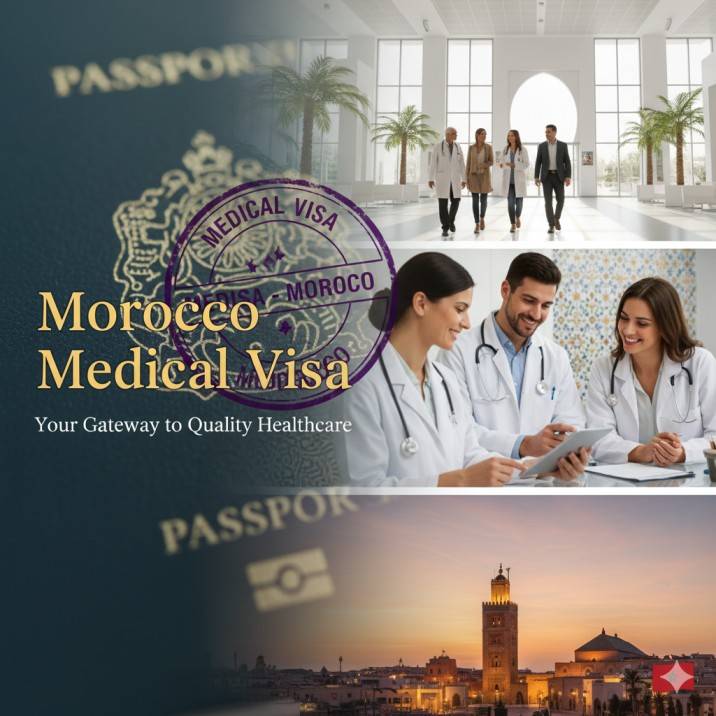
Traveling to Morocco for medical care is increasingly popular as the country invests in modern hospitals, private clinics, rehabilitation centers, and specialist facilities for cardiology, orthopedics, oncology, cosmetic surgery, and advanced diagnostics. Visitors must obtain a Morocco Medical Visa unless their nationality is visa-exempt.

This guide provides clear, accurate and detailed information regarding eligibility, requirements, procedures for visas, hospitals, costs, and traveling safely for treatment. Each and every aspect is formulated to assist you in making a safe and sure preparation, especially when it is your very first medical trip abroad.
Who Needs a Medical Visa to Enter Morocco?
Most nationalities from Europe, North America, Australia, Asia-Pacific, and many African regions can visit Morocco visa-free for up to 90 days. These travelers can receive basic treatments, emergency care, or short consultations without a pre-approved visa.
However, you must apply for the Medical Treatment Visa Morocco if:
Your nationality is NOT visa-exempt
Your treatment exceeds 90 days
You require a scheduled surgery or specialist procedure
You need an accompanying caregiver
You plan repeated treatment sessions within a defined period
A Moroccan hospital requires you to present a medical visa
Visa-exempt entry is suitable for quick consultations, short procedures, and basic follow-ups, but complex or extended medical care always requires a formal application.
Eligibility Criteria for Morocco’s Medical Visa
Morocco requires applicants to meet a specific set of eligibility conditions to ensure that medical travelers are genuine and have approved treatment arrangements. You are eligible if:
You have a confirmed appointment, admission letter, or treatment plan from a Moroccan hospital or clinic
You hold a passport valid for at least six months
You demonstrate the ability to cover treatment and living expenses
You possess valid medical insurance OR a financial guarantee
You do not have any legal or travel restrictions
If your treatment includes a surgical procedure or extended hospitalization, Morocco may ask for additional clarifications before approval. This is common in long-term recovery cases or chronic treatment programs
What documents are needed for Morocco Medical eVisa?
Applying for a Morocco Medical Visa requires complete, clear, and properly formatted documentation. Immigration officers focus heavily on the Morocco Visa Requirements, so it’s important to prepare everything carefully. You must submit

Completed Entry Visa Application Form
You must fill out the Moroccan medical visa application form accurately and completely.
Ensure that all details match the information in your supporting documents.
Recent Colour Photographs
Two recent passport-sized color photographs on a plain white background.
The photographs must clearly show your facial features without any obstructions such as hats or sunglasses.
Valid Passport
Must be valid for 6 months from the planned date of return. Photocopy of the identity details, validity, and previous visas.
Medical Certificate / Diagnosis Report
Your passport must be valid for a period longer than your intended stay in Morocco.
A photocopy of all relevant passport pages, especially those showing your identity details and passport validity, is required.
Hospital Acceptance Letter (Mandatory)
Confirmation of appointment or admission
Details of the treatment plan
Expected duration of stay
Whether a caregiver may accompany you
Financial Proof or Sponsorship
Bank statements (last 3 months)
Health insurance covering treatment and repatriation
Sponsorship letter with financial documents
Flight Reservation & Accommodation Proof
A reservation is acceptable; a fully paid ticket is not required unless your consulate specifies it.
Types of Visas Used for Medical Travel to Morocco
Although Morocco does not issue a separate medical-only sticker, you will use one of the following categories:

Short-Stay Visa
For treatments lasting up to 30 days:
Specialist consultations
Outpatient procedures
One-week or monthly treatment cycles
Post-operative short recovery
Long-Stay Medical Visa
For treatment exceeding 90 days:
Long-term therapies
Major surgeries requiring extended recovery
Rehabilitation programs
Chronic illness management
Upon arrival, long-term patients must register for a residency permit based on medical necessity.
How to apply for a medical visa?
Here is the simple, accurate pathway to apply:
Check Whether You Need a Visa
If you’re not visa-exempt, you must apply before traveling.
Choose the Right Visa Duration
Under 90 days → Short-stay visa
Over 90 days → Long-stay medical visa
Confirmation a Medical Admission Letter
Contact your chosen hospital for a treatment plan, appointment confirmation, or surgery schedule.
Prepare All Required Documents
Double-check your medical papers and financial proof.
Submit Your Application
Apply through the Moroccan embassy, consulate, or approved visa center.
Processing generally takes 3–6 days depending on the Medical Visa Processing Time Morocco guidelines.
Receive Your Visa & Prepare to Travel
Carry printed copies of your visa, medical reports, hospital admission letter, insurance, and address details.
Morocco Medical Visa Processing Time
The standard Medical Visa Processing Time Morocco ranges between:
3–6 working days for most short-stay cases
7–12 days for long-stay or complex medical programs
Delays happen if:
Medical reports are unclear
Financial documents are insufficient
Hospital letters lack essential details
Passport scans are not readable
For emergencies, consulates may accept fast-track requests
Morocco Medical Visa Costs
The Morocco Medical Visa Cost vary slightly by nationality and consulate, but generally include:
Visa application fee
Possible service charge at visa centers
Optional express handling fee
Hospital admission and treatment fees must be arranged directly with your Moroccan medical provider. Each clinic has its own pricing policy, which is not linked to the government visa fee.
How Long Is the Medical Visa Valid?
The Morocco Visa Validity depends on treatment duration:
Short-stay visas: valid for up to 90 days
Long-stay visas: valid for entry and later converted into a residency card
Multi-entry availability only if approved in advance
Always check both the entry validity And duration permitted after arrival.
Duration of Stay for Medical Treatment
The Duration of Stay Medical Visa corresponds to what your hospital recommends. Short procedures may require a week, while major surgeries could need months of recovery.
Travelers must not overstay; extensions are available only with updated medical proof.
Can You Get an Urgent Morocco Medical Visa?
If your condition requires faster approval, such as emergency surgery, sudden specialist referral, or urgent medical evacuation, you may apply for an Urgent Morocco Visa at the embassy.
Approval depends on:
Updated medical justification
Hospital’s urgent acceptance note
Availability of fast-track appointments
This option is not guaranteed but is often granted for life-threatening or time-sensitive cases.
Can I Extend a Medical Visa in Morocco?
Yes. If your treatment requires additional time, you may extend the visa by submitting:
Updated medical reports
A continuation letter from the Moroccan hospital
Proof of financial ability
Passport validity confirmation
Long-term patients usually shift to temporary residency.
Is Morocco Safe for Medical Travelers?
Morocco is generally safe for foreigners, including patients and caregivers. Major cities like Casablanca, Rabat, Marrakech, and Tangier have high-quality private hospitals, accessible transport, English-speaking staff, and reliable emergency services.

Essential Tips for Medical Visa Applicants
When coming to Morocco, do not forget to bring with you the printed copies of important documents.
Keep regular communication with your hospital in Morocco for updated or new documents.
Make sure your passport is valid for a sufficient period of time.
If medical reports are in a language other than English, French, or Arabic, have them translated.
In case a carer is travelling with you, mention his/her name in the hospital letter.
If not asked for, do not use a fully paid ticket but only a flight reservation.
Especially if you are planning to undergo treatment for a long time, start your application early.
Generally, Morocco does not provide visas on arrival and hence a visa for medical purposes has to be obtained prior to travelling.
Final Thoughts Planning Your Medical Trip to Morocco
Applying for the Morocco Medical Visa is a straightforward process when you prepare your documents carefully, coordinate with your hospital, and choose the right visa type for your treatment duration.

The Morocco eVisa is designed for tourism and business. Although minor medical visits can sometimes fit within a 30-day stay, serious treatment is not recommended through the Visa category. Morocco’s growing healthcare system, combined with experienced specialists and well-equipped clinics, makes it an excellent destination for international patients seeking professional care in a safe environment.
👉 Further Reading:📘 Moroccan Visa Guide for Nauru Citizens
You may also like:
🌍 Morocco Visa Guide for Thai Citizens
Related Post:
📝 Morocco Visa Guide for Sri Lankan Citizens
Don’t miss:
✈️ Morocco Visa Guide for South African Citizens
Also check:
🔖 Morocco Visa Guide for Montenegrin Citizens
No comments yet
Be the first to share your thoughts!